
Firstly what prompted you to start making gin?
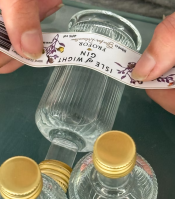
Four years ago, on our former working farm in the heart of the Isle of Wight, we bought Copper stills, gathered botanicals and bottles and set about creating what would become the Isle of Wight Gin Company [1] and Island Spirits Distillery. The motivation to start making gin came from a love of flavour, the Island and the possibility of creating something genuinely different. We were not interested in simply producing another London Dry Gin and adding it to an already crowded drinks market. If we were going to make spirits, we wanted those spirits to have a reason to exist. The first sale was pleasingly local: gin supplied to a nearby pub. It was a modest beginning, but an important one, the moment an idea became a real business.
The drinks marketplace has been overcrowded for years, what did you bring to the market that wasn't already there?
Part of the difference came from something very unusual. Leigh has synaesthesia, a neurological trait in which the senses can overlap. For her, flavours and aromas can create impressions of colour, shape and texture. Rather than developing recipes solely around conventional flavour combinations, she can construct them almost as she would build a painting, adding, balancing and changing ingredients until the finished spirit creates the picture or feeling she is looking for.
That approach became particularly important when the company created its range of ‘Mood Gins'. Instead of beginning with the question of what flavour a gin should have, we began by asking how they wanted someone to feel when drinking it. Gigglemug was created around the idea of joy, with bright notes of pink grapefruit, lime leaf and lemon balm. Lufsum represents love, combining raspberry, pomegranate, Damask rose and hibiscus, while Frofor was developed around comfort, with softer botanicals including lavender, passion flower and lemon verbena. It gave the fledgling distillery a distinctive voice in a market already filled with hundreds of gin brands. Alongside the Mood Gins sits Island Spirit, created to capture something less tangible: the feeling of a breeze on an Isle of Wight summer's day. Blackberry, honeysuckle, apple and calendula come together in a gin designed to evoke the place where it is made rather than simply taste of a particular ingredient.
The Island itself plays an important part in many of the recipes. Where practical, botanicals are grown or sourced locally, while the landscape and people around the distillery provide both ingredients and inspiration. Over the past four years, we have gradually learnt which botanicals work beautifully in a still and which can be considerably less cooperative. Small-batch production also involves a surprising amount of work by hand. Lemons, for example, need to be peeled carefully to capture the zest without too much of the bitter white pith underneath. It means hand-peeling fruit is a regular job at the distillery, but the difference it makes to the finished flavour means some shortcuts simply are not worth taking.
Why stray into rum and vodka?
Other ingredients come through relationships with people nearby. One of the botanicals used in the distillery's spiced rum, for example, is harvested locally from a neighbour, the sort of connection that would be difficult to reproduce if the spirits were being made anonymously on an industrial estate. Rum became a natural progression. Once we become confident working with botanicals in gin, we wondered what might happen if we applied the same thinking to other spirits and rum became a natural progression. The RockenEnd rum range grew from that idea. Rather than trying to imitate established Caribbean rum brands, the intention was to create rums with their own Island character.
The range now includes White, Dark Spiced and Navy rums alongside flavoured expressions developed with other Island businesses and ingredients. Sea Salted Caramel uses Isle of Wight sea salt, while the coffee for Caffè Mocha is roasted locally in Cowes. This year brought the distillery's strongest spirit yet: Privateer Rum at 70% ABV.
Strength alone, however, was never the objective. We spent around a year and a half developing it because we did not simply want to produce a high-proof rum as a novelty. The challenge was to create something exceptionally strong that was also genuinely enjoyable to drink. The result is a spirit where flavour, rather than the number on the bottle, remains the point. That ability to create flavour around a story has also led to some of the distillery's most personal collaborations.
We have also developed bespoke gins for a number of Isle of Wight charities and attractions. Rather than producing a standard gin and changing the label, each recipe is developed specifically for the organisation. Botanicals are chosen to help tell its individual story and, in some cases, even evoke the scent and character of the place itself. Each gin is then sold exclusively through the organisation it was created for, giving the charity something that visitors cannot buy anywhere else. Despite that growing range, the operation remains deliberately small-batch and hands-on. This is not a production line where a recipe is created once and then handed over to an automated factory. Distilling, developing recipes, preparing botanicals and bottling all remain part of everyday life.
Has the business crossed the Solent or maybe the Channel as yet?
The drinks themselves, are beginning to travel further. Island Spirit has even been served in the Houses of Parliament, taking a little Isle of Wight distilling to Westminster. The company has also collected recognition at international drinks competitions, demonstrating that spirits developed in a small Island distillery can hold their own alongside products from much larger producers.
What does the future look like?
The challenge now is deciding how far to take the business. The existing distilling equipment was bought for a considerably smaller operation, and as production grows its limitations are becoming increasingly apparent. Opportunities are emerging on the mainland, there is potential to build a more national presence and conversations about markets further afield make the prospect of exporting feel less distant than it once did. However, expansion brings its own questions. Growth is not simply about producing more bottles. The challenge is to grow without losing the things that made the business interesting in the first place: Island provenance, unusual botanicals, small-batch production and a very personal approach to creating flavour. There are more spirits in development and an increasing focus on botanicals as the thread that connects everything the distillery produces. Gin may have been where the story began, but rum, vodka and whatever comes next are all becoming chapters in the same story. Four years after that first delivery to a local pub, the business is still evolving.
Perhaps that is what best defines the Isle of Wight Gin Company [2]. It was never created simply to fill another space on a drinks shelf. It grew from a former Island farm, a fascination with flavour and a belief that a spirit can tell a story about the place it comes from. And there are still plenty of Isle of Wight stories left to tell.