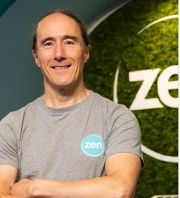
Thirty years in any business is an age, can you take us back to the early 1990s - what inspired you and your brother Dan to start Zen Internet, and why an ISP?
I had always wanted to run my own business. It was an ambition that went all the way back to primary school.
In the early 90s, while working as a computer hardware designer, I spent time with friends batting around business ideas. We called the discussions "board meetings", and held those meetings in the pub after work.
In 1993, I gave up my job to go travelling, knowing that when I got back, I was going to make my childhood dream a reality and go into business. During my 9 months travelling, I spent some time reading a management book - Thriving on Chaos by Tom Peters - to try to educate myself on how best to run a business. Then when I got back in 1994, I set up Zen Microsystems Ltd. None of my "board meeting" friends wanted to give up their jobs to join me, so it was just me. I started trying to sell my services as a computer hardware designer, but found that there was more demand for software development, so I became a software contractor.
I first heard about the Internet in 1995, while working on one of my software contracts. It sounded particularly interesting as a business opportunity, because of the promise of recurring revenue. In comparison, every time I wanted to make more money as a software contractor, I had to write more code. I likened the Internet opportunity to the boom in mobile phone companies in the 90s, and thought naively that once I'd sold an Internet account, I could just sit back, sip my cocktail, and watch the money roll in. No surprise that the reality was very different - I had to work very hard to keep the money rolling in!
With the business idea in my head, I met my brother Dan in the pub, and asked him, "do you think the Internet will take off?" I'd never used the Internet, but Dan had used it at university - he was doing research into AI there. He said "yes". I then asked him if he'd like to set up an ISP with me. He said he would be willing to get involved for the first 6 months to build the network, but that he had no interest at all in being in business, and that after 6 months he'd go back to his research. That sounded good to me. It was game on!
What was the very first step you took to get Zen Internet off the ground - was there a defining moment when you said, ‘We're doing this'?
The defining moment was the pub chat with Dan. I knew after that chat that we were going to give it our best go.
I'd saved up £5,000 from my software contracting work, and that was enough to get going.
The very first step was to rent a small office in Rochdale, and for Dan to build the network. The network he built could cope with just six customers online at the same time, connected using dial-up modems - devices that made a phone call to get online, and transmitted data using audio beeps and whistles. These were the days before broadband.
Whilst Dan was building the network, I hired an Operations Manager to run the business, and an admin assistant to help out. The idea was that I would keep writing software to fund the venture, whilst the 3 of them launched the ISP business.
I registered Zen Internet Ltd as the company name, and we opened our doors for business in October 1995. We sold our first dial-up Internet access account for £10/month. I remember thinking that we were going to need a lot of those £10s to pay the bills!
The internet was still in its infancy - what were the biggest challenges in setting up an ISP in those early days?
The biggest challenge was getting the business to make any money. As with most businesses, I needed to put the money in up front, and then hope that my investment would pay off in the longer term. My initial £5,000 soon ran out, and my software contracting work wasn't generating enough to fund the business in the early years.
My solution was to borrow money from friends and family. The banks weren't interested, as I had no security to put up against a loan. I ended up borrowing about £25k from friends and family. I paid a good rate of interest - 10% APR. I told everyone who lent me money that I would definitely pay them back, with interest, but that if Zen Internet failed, they would have to wait for me to pay them back with my software contracting work.
It took us 4 years of hard work before we made our first profit. It was like trying to run up a down escalator, trying really hard to get the money coming in faster than it was going out.
The other challenge was the challenge of managing people. I'd never managed people before, and like most new managers, found some aspects of it challenging. Especially when I hired people who turned out to be not right for the job. For the most part though, we hired a great team of people who did a brilliant job of making my start-up idea a success.
How did you and Dan divide your roles in those first years? What was the dynamic like between you two as co-founders and brothers?
The role that Dan signed up to was to build the network and then leave after 6 months. Inevitably, he got involved much more widely in running the business, particularly because I was initially half way across the country writing software. He stayed for the first 18 months in the end, before going back to his AI research.
Dan and I always got on well. It always felt like a great team effort. When I moved back to Rochdale to focus on Zen Internet full time, we both lived at our parent's house, mainly due to not being able to afford to have our own places. We'd sometimes get woken up in the middle of the night by Dan's automated network monitoring system, and I would drive us down to the office to fix something that had broken. That happened a few times. Looking back, it was all part of the fun and excitement, even though I would have chosen to have a good night's sleep at the time.
We recruited someone else to look after the network, and then Dan left to go back to his research, as was always his plan.
Looking back, were there any key decisions in the first five years that turned out to be crucial for Zen's survival or growth?
The main key decision in the early years was not giving up, despite the business making no money. It came good in the end.
One of my big concerns in the early years was that either BT or Microsoft would realise just how big an opportunity the Internet was, and would give Internet access away for free for a couple of years to drive all the small players out of business, and then have the market to themselves.
My fear became reality in 1998; however, it wasn't BT or Microsoft, it was Dixons with the launch of Freeserve. All of a sudden, the service we were charging £10/month for was free from Freeserve. Customers started to phone up to cancel their services, saying that although they loved our service, they couldn't justify paying for something that was free elsewhere.
I feared the worst, but Freeserve turned out to be a blessing in disguise. In the year that followed, Zen more than doubled turnover to £900k and we made our first ever profit of £100k.
The threat turned into a great opportunity for two reasons. Firstly, Freeserve only provided free access to consumers, not to businesses. That forced us to adapt and focus our efforts on our business customers. Our business customers were typically much more profitable than our consumer customers, so Freeserve was the catalyst that made us focus on the more profitable part of our business.
Secondly, with Internet access now free from Freeserve, there was a huge surge in Internet usage in the UK. With so many more consumers online, businesses took the Internet much more seriously as a business tool and demand for Zen's business services rocketed.
The key decision was to adapt to the changing market, something that remains critical to this day.
At what point did you feel Zen Internet was no longer a small startup but a serious player in the industry?
There was one very clear point when I thought "I've made it!" It was in 2001 when we moved into our new high-tech office.
In the early years of Zen, we were based in some drab industrial units. Most of the offices had no windows, and many got sweltering hot in the summer under the tin roof.
The business in the next office to me was a one-man architect firm. I got chatting to him, and hatched the idea to build a high-tech glass and aluminium HQ, more fitting for us as a technology company. We bought a plot of land from Rochdale Council, and we built our HQ on it.
The day we moved in, I sat in my new corner office, with glass on both sides, opening windows, and a view of Rochdale canal and the hills. That's when I thought "I've made it".
Zen was still a small business though, with 30 people and annual revenue of £2m. The new building was fantastic, but it was expensive. Combined with our investment in broadband - the new Internet access technology that had launched a year earlier - the increased costs pushed Zen to the edge financially.
Our transition to becoming a serious market player was much later. I'd say within the last 10 years.
How did Zen manage to stay independent in a space where many ISPs either folded or got acquired?
I own 100% of Zen, so it has always been in my gift whether to remain independent or sell out, and I've always chosen the former, despite many approaches from potential acquirers. I've always wanted Zen to be different. People focussed.
Over the years, I've formed a view that the capitalist system that we all live and work in is not sustainable long term, for the wellbeing of society or for environmental sustainability. The capitalist system's focus on money drives massive inequality - making the select few obscenely rich at the expense of the majority and at the expense of the environment.
Businesses have, I believe, the biggest part to play in evolving capitalism into a system that is sustainable, taking the good side of capitalism - primarily free market competition - but dispensing with the over focus on money for money's sake.
I want Zen to set an example of what a business could look like in an evolved and sustainable version of capitalism. Our purpose is to "do right for people and planet". We exist as a business for the good of people and the environment. Money is essential. It's the fuel that keeps us going and growing. But it is subservient to our people- and environment-centric purpose. It is a means to an end to achieve our purpose.
Zen's purpose, culture, and values are so deeply important to me that I have vowed never to sell the company. When I die, my shares will go into a trust, and my letter of wishes to the trustees says, "stick to the values, don't sell out".
What were some of the high points in Zen's journey over the decades - moments that made you especially proud?
Some of the highest points are when long serving employees tell me how much they love and value the culture at Zen. It's a great affirmation that I'm doing the right thing.
We have won many awards over the years for our service, and that's a fantastic feeling. A particular stand out is the PC Pro Best Broadband ISP award, that we've won for 22 years on the run - every year since 2004. Incredible!
The ongoing high point is working with so many great people and enjoying the journey. It's the journey that matters most. Our goals are important of course, but the journey is more important.
And on the flip side, what were some of the lowest or most challenging moments you had to navigate as a founder?
The biggest challenge that springs to mind is when I decided to step back into the non-exec Chair role, but then later had to resume my role as CEO due to Zen's profitability taking a nose dive. I have no regrets, but it was a difficult time. Fortunately, profits came back, and we now have a bright future ahead.
Zen is known for its strong ethical and customer-focused culture. How have you maintained that as the company has grown?
If you want a certain culture and set of values within any organisation, you have to continually work at it, and you have to truly live those values. Zen's values go right to our core, and we genuinely live them. This is very different to a company that talks about culture and values, but whose ultimate goal is to maximise financial return to shareholders.
Over the years, people have told me that it will be difficult to retain our culture and values when we have more than 50 people, 100 people, 200 people, or 500 people. They said that Zen has to become more "corporate". It's unavoidable. I've learnt that they were wrong. There is no employee number that forces a change of culture. If you want a people-focused culture, you can have that with 10 people or 10,000 people. It is true though that with more people, you need to do more to communicate and embed the culture.
What does the future look like for Zen Internet in the next 5-10 years - are there new directions, technologies, or challenges you're preparing for?
We have a huge ambition to become the UK's Alt-Net aggregator of choice, providing access to the most comprehensive full fibre footprint of any provider. We're well on the journey, with partnerships signed with CityFibre, Trooli, Freedom Fibre, ITS, MS3, one more soon to be announced, and several discussions ongoing with others.
There is a great opportunity over the next few years to win market share as the UK transitions to full fibre broadband, and Zen, along with our partners, are striving to make the most of that opportunity - to make hay while the sun shines.
We see AI as a huge opportunity. We have already developed and deployed industry leading chatbots, and intend to build upon these with much richer AI functionality. It's certainly an exciting time in the world of AI.
Finally, we intend to stay true to our purpose to "do right for people and planet", and our most-fundamental long-term people objectives, in priority order, of "Happy staff", "Happy customers", and "Happy suppliers". We'll also continue our journey as part of the global B Corp movement, whose mission is to transform the global economy to benefit all people, communities, and the planet.